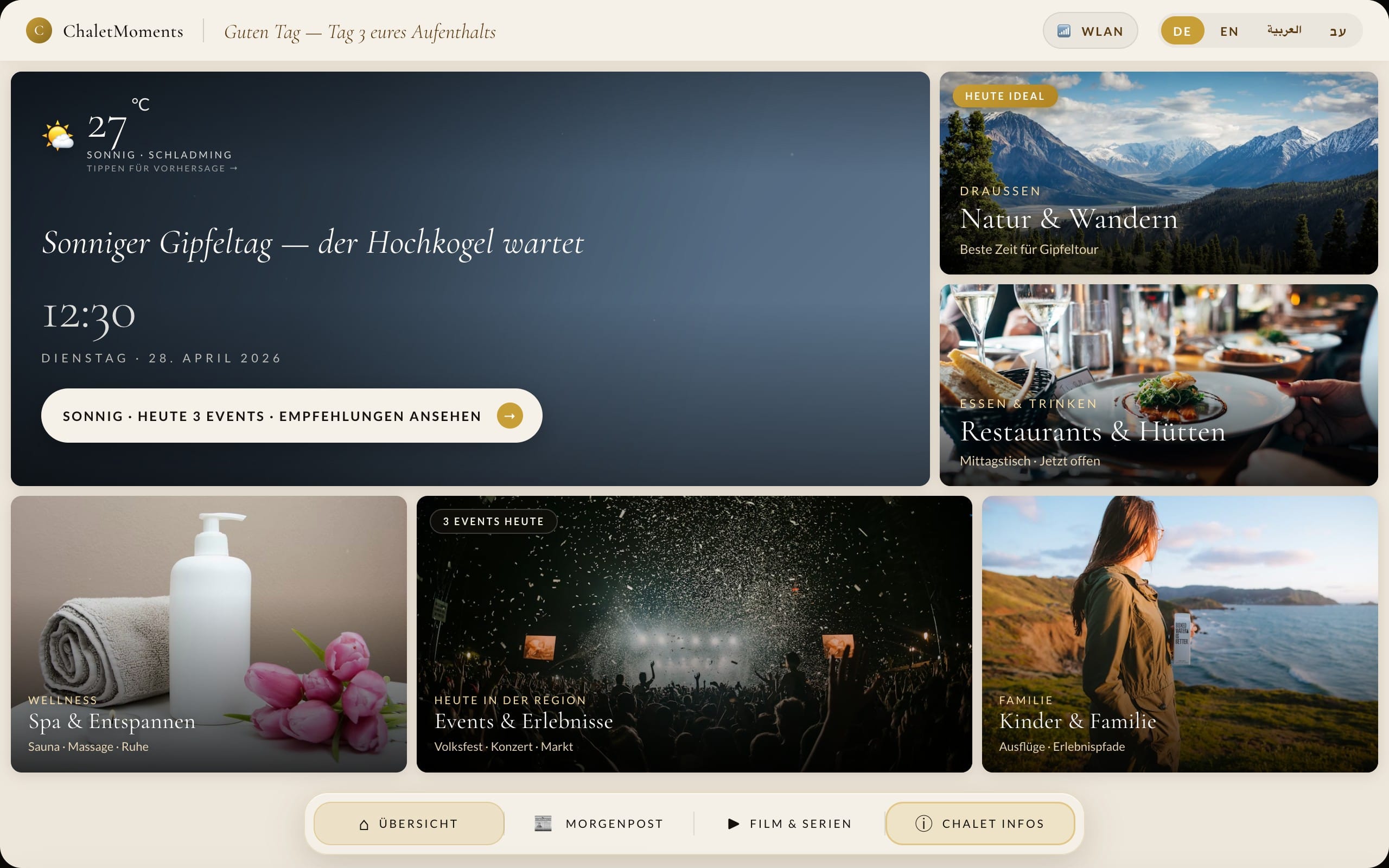
Thirty chalets, three valleys: what a winter with ChaletMoments actually produced
In December 2025 the first tablet went into a chalet in Styria. Today there are thirty of them across three alpine regions — through a full winter, a shoulder season and the summer after it. This is not a projection. It is an account of what was installed, what guests actually used, and what did not work.
Measured, not estimated
- 30
- chalets in service
- 3 regions: Schladming-Dachstein, Kreischberg, Turracher Höhe
- 148
- completed guest stays
- guests who arrived and departed with the tablet in the house
- 87%
- WhatsApp read rate
- 243 of 279 delivered messages were read
- 8
- languages guests chose
- from German and English to Dutch, Hungarian, Czech
Every figure is drawn from the production database as of 22 September 2026 and can be reproduced on request. Per-chalet revenue impact is deliberately not listed here — it is being re-derived across the full season and will appear only once it holds up.
The starting point: a printed binder and five hours of questions a week
The chalets were never the problem. Everything around them was: a printed binder remade twice a year and out of date anyway, a sheet of Wi-Fi codes, and an operator answering the same eight questions — which restaurant opens on Sunday, where to go when it rains, how the dishwasher cycle works. On average five hours a week, all year, per active chalet.
The rollout: one tablet per chalet, staged across three regions
It began in December 2025 with single chalets in Schladming-Dachstein and grew across the season to thirty in three valleys. Each tablet runs in kiosk mode as Device Owner — it cannot be repurposed, updates arrive over the air, and a GPS geofence locks the device if it leaves the property. Commissioning a chalet now takes under an hour.
What guests actually used
Across 148 completed stays a clear pattern emerged: reading happens in the morning, buying happens on impulse, and choices follow the weather. 66 orders went through Shop Moments — Brötchen for the next morning, a bottle from the region — billed straight to the stay at the tablet. Guests selected eight different languages, among them Dutch, Hungarian and Czech: languages a printed binder was never going to cover.
WhatsApp: 279 messages delivered, 243 read
Before arrival and on departure morning, the house writes to the guest — on the operator’s behalf, in the guest’s language. Of 328 messages sent, 279 were delivered and 243 were read: an 87% read rate, several times what email achieves in the same role. This is the channel early check-in and late checkout are offered through — not as advertising, but as an offer from the house.
What did not work
Not everything landed. The tablets are consumer hardware on six gigabytes of RAM; without stripping the stock Google image back, the interface occasionally froze and then replayed every queued tap at once — fixed, but only after a diagnosis in the field. One device went dark for days because the OS had reaped the whole process and nothing restarted it; there is now a watchdog that lives outside the process. And the analytics themselves had gaps: some events were only captured completely over the course of the summer, which is why this page shows only figures we can evidence across the whole period.
What comes next
Room Check — AI-assisted inventory verification for housekeeping — has been running in three chalets since February and is growing with the fleet. ChaletMoments to go puts the day’s edition on the guest’s own phone, with no app and no account. And self-checkout on departure morning is built and going into service next: settle what is open, four optional photos, deposit released on the spot, keys left on the dining table.
See it in a chalet, not in a slide deck.
We will walk you through the setup on a real device and go through the numbers that matter to you — including the ones that are not on this page.